

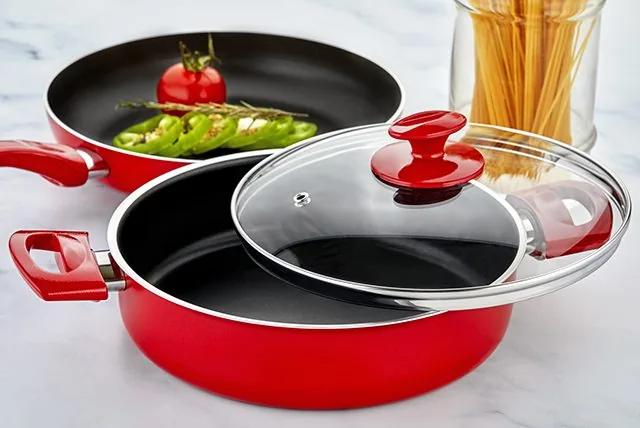
Pressed and forged aluminium pans both start life as the same thing: a round aluminium disc punched from sheet. The difference is how hard that disc is worked. Pressing shapes it into a pan; forging squeezes it under far greater force, which leaves a denser, thicker, more warp-resistant body.
Both start from a disc
A cookware factory does not pour aluminium into a pan mould. It cuts a circular blank — a disc, or circle — from aluminium sheet, and forms that blank. Papilla produces these discs in-house through its own group, which is why the same company can talk about both the blank and the finished pan. If you want the raw material rather than the cookware, see aluminum discs and circles.
What pressing does
In pressing, the disc is drawn into shape in a die. It is the established, efficient way to make cookware and it produces a light pan with even walls. Papilla's pressed models include the Fred and Ragnar grill pans and the double-sided round cast grill pan. A pressed body keeps weight down, which matters for retail shelves and for shipping cost per unit.
What forging adds
Forging works the same disc under much higher pressure. The metal is compacted rather than merely bent, so the finished body is denser and typically thicker, which makes the whole pan heavier. In practice that means better resistance to warping on high heat and a pan that holds its shape over a longer service life. Papilla's Vilma grill pan and cast Grillmatic are produced with forging technology.
One caution worth knowing as a buyer: "forged" is used loosely across the industry, and some of what you will read is marketing rather than engineering. Independent warping data is scarce. Ask for the body thickness in millimetres and the production method in writing, and judge on those numbers rather than on the word.
Which one should you buy?
- Everyday retail, price-sensitive ranges: pressed. Lighter, lower cost per unit, perfectly sound for normal domestic heat.
- Heavy or professional use, high heat, long service life: forged. The extra body is what survives a commercial hob — see the HoReCa cookware guide.
- Induction: the production method is a separate question from the base. Either body can carry an induction base — see what an induction base is.
What this means for a private-label brief
If you are specifying a range under your own brand, the production method is one of the few decisions that changes both the feel of the product and its landed cost. State it explicitly in the brief alongside the thickness you want — see cookware thickness — and it will be quoted and sampled against that specification. The approved sample then becomes the reference the production run is checked against.
Frequently asked questions
Is forged aluminium better than pressed?
For heavy or high-heat use, usually yes: forging compacts the same aluminium disc under far greater force, so the body is denser and typically thicker and resists warping better. For normal domestic cooking a pressed pan is perfectly sound, lighter and cheaper. Note that "forged" is used loosely in the trade — ask for the body thickness in millimetres and the production method in writing.
Is forged aluminium safe for cooking?
Yes. Forging changes how the aluminium body is formed, not what it is or what touches your food. The cooking surface is the coating, and that is what food-contact compliance covers — the same for a pressed or a forged body.
Which Papilla grill pans are forged and which are pressed?
The Vilma grill pan and the cast Grillmatic are produced with forging technology. The Fred and Ragnar grill pans and the double-sided round cast grill pan are produced with the pressing technique. Every product page states the method.
Does the production method affect induction compatibility?
No. Induction compatibility comes from a ferromagnetic steel layer bonded into the base, which can be applied to either a pressed or a forged body. Check the base, not the forming method.