

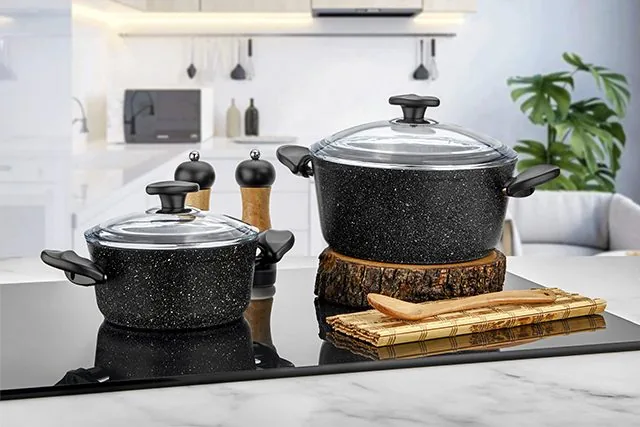
Cookware thickness is the thickness of the metal body, given in millimetres. It is the single number that best predicts whether a pan will stay flat, heat evenly and last — and it is the number most often quoted in a way you cannot actually compare. Papilla pans are made to the same thickness on the base and on the walls. Not every pan is, and that is where comparisons go wrong.
One figure is not enough
A pan has a base thickness — the cooking surface — and a wall thickness, the side. They are not necessarily the same. Metal thins as it is drawn up the side of a form, so a thick disc can become a pan with a heavy base and a noticeably thinner wall. A supplier can then quote the base figure on its own: technically true, and misleading.
A "4 mm pan" whose wall measures 2 mm or less is not a 4 mm pan. It is a 4 mm base with a thin body attached, and it will not feel, weigh or last like the pan you thought you were comparing. So compare bodies, not bases: ask for both figures in writing, and ask whether they are equal. Papilla quotes one thickness that holds across the whole body — the Ragnar grill pan at 1.8 mm is 1.8 mm on the base and 1.8 mm up the wall, not 1.8 mm where it is easiest to measure.
Why thicker resists warping
A thin base expands unevenly when it meets a hot ring, and once it has flexed past its limit it does not come back — you get a pan that rocks on a glass hob and develops a hot spot in the middle. More metal distributes that stress. Thin standard aluminium pans are the ones most prone to warping. Thin walls show up differently: the rim loses its stiffness, so the pan flexes when it is lifted full and the handle joint takes the strain. The trade-off is that more metal means more weight and more cost, which is why thickness is a commercial decision and not simply "more is better".
Thickness and even cooking
Aluminium conducts heat very well, which is why it is the dominant cookware metal. A thicker body gives that conductivity more material to work with, so heat spreads sideways from the burner rather than concentrating in a ring. This is most noticeable on a small gas burner under a large pan.
An induction base changes the stack
On an induction-ready pan the base is not one material. A ferromagnetic steel layer is bonded under the aluminium, so the total base is thicker than the aluminium figure alone. Compare like with like: ask whether a quoted base thickness includes the induction plate. See what an induction base is.
What to specify in an OEM brief
- Wall and base thickness separately, in millimetres, with a tolerance — and whether they are equal. One figure for the whole body is the cleanest specification to write and to check.
- Production method — pressing or forging changes what a given thickness feels like. See pressed vs forged.
- Base finish — rectified or stamped — since a flat, machined base is what sits properly on a ceramic hob.
- Hob types the range must serve, because that determines whether an induction plate is needed at all.
Put those four lines in the brief and the quotation and the sample can both be checked against them. Thickness is also one of the easiest things to verify on arrival, which makes it a good anchor for pre-shipment inspection.
Frequently asked questions
How thick should a frying pan be?
There is no single correct figure — it is a trade-off. More metal resists warping and spreads heat better but costs more and weighs more. What matters is that the thickness is stated for the whole body, in millimetres with a tolerance, so you can compare two offers and check the goods on arrival. Papilla's Ragnar grill pan, for example, is 1.8 mm on the base and 1.8 mm on the wall.
Why does a pan warp?
A base that is too thin for the heat applied expands unevenly, flexes past its limit and does not return. The result rocks on a flat hob and develops a hot spot. Thin standard aluminium pans are the most prone to it; more base thickness distributes the stress.
Is the base thickness the same as the wall thickness?
On Papilla cookware, yes — the body is made to one thickness, base and walls alike. Elsewhere it often is not, because metal thins as it is drawn up the side of the form. That is why a pan advertised as 4 mm can have a wall of 2 mm or less. Ask for both figures and compare bodies, not bases.
Does an induction base count towards the stated thickness?
Ask, because practice varies. An induction-ready pan has a ferromagnetic steel layer bonded under the aluminium, so the total base is thicker than the aluminium figure alone. Compare like with like before concluding one pan is heavier-gauge than another.