

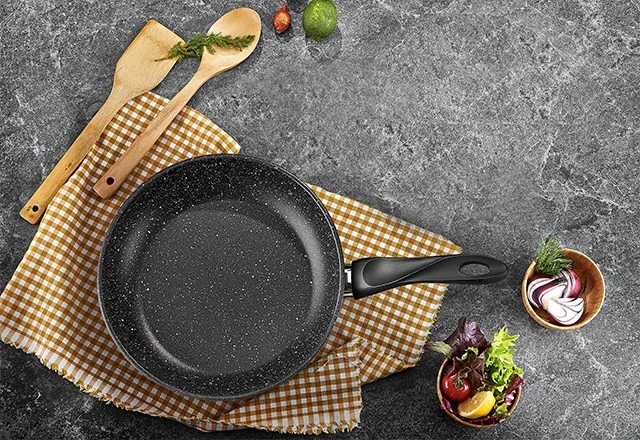
In the cookware trade, "granite" describes a look and a coating build, not a stone material. A granite-finish pan is an aluminium pan with a speckled, mineral-look non-stick surface, usually built up in several reinforced layers. The honest way to compare it with a plain PTFE finish is to read the technical data sheet, not the name.
What a plain non-stick coating is
Standard non-stick cookware uses a PTFE-based coating — the chemistry behind the familiar slippery surface. It releases food with very little fat, and it wears according to how it is treated: heat, metal utensils and abrasive cleaning shorten its life. The mechanism and the safety questions are covered in non-stick cookware coatings explained.
What "granite" actually refers to
The speckled finish is the first thing a shopper notices, and it is partly decorative. Beyond the appearance, granite-type coatings are typically applied as a multi-layer, reinforced system, which is a recognised way to improve wear resistance on a non-stick surface. What is not publicly standardised is the composition — there is no common formulation behind the word, and manufacturers describe their own differently.
This matters commercially. Two pans both sold as "granite" can be built very differently. As a buyer, treat the word as a finish description and then ask the specific questions below.
Papilla's two options, as specified
Papilla publishes both. Most of the range carries a non-stick (PTFE) interior; some models are coated inside and out. The Ragnar series is specified with a granite non-stick interior and a silicone-polyester exterior, at 1.8 mm. Both run on the same aluminium bodies, so the coating choice is independent of the pan shape or the production method — see pressed vs forged.
What to ask before you choose
- The technical data sheet for the coating, from the coating supplier, with the number of layers.
- Food-contact compliance for your destination market — see certifications and compliance.
- Maximum service temperature, and whether the pan is rated for oven use.
- Abrasion test results, if durability is the selling point of the range.
Which one for which market
A granite finish sells on appearance and on a perception of toughness, which suits mid and upper retail shelves. A plain PTFE interior is the efficient choice for volume ranges and for sets. Neither is "the healthy one" — care practice decides a coating's life far more than the label does, and the rules are the same for both: moderate heat, no metal utensils, no abrasives. See non-stick pan care.
Frequently asked questions
Is granite cookware actually made of stone?
No. A granite-finish pan is an aluminium pan with a speckled, mineral-look non-stick surface. "Granite" describes the appearance and the coating build, not a stone body — and there is no single standard formulation behind the word, so ask for the coating's technical data sheet.
Is a granite coating better than PTFE?
It is usually built as a multi-layer reinforced system, which is a recognised way to improve wear resistance, and it sells on appearance and a perception of toughness. But two pans both labelled "granite" can be built very differently. Compare data sheets, layer counts and abrasion results rather than names.
Which Papilla series has a granite coating?
The Ragnar series is specified with a granite non-stick interior and a silicone-polyester exterior, at 1.8 mm. Most of the rest of the range carries a non-stick (PTFE) interior, and some models are coated inside and out.
Does a granite coating need different care?
No. The rules are the same for both: moderate heat, no metal utensils, no abrasive cleaning, hand-washing for a longer life. Care practice decides a coating's life far more than the label on the box.