

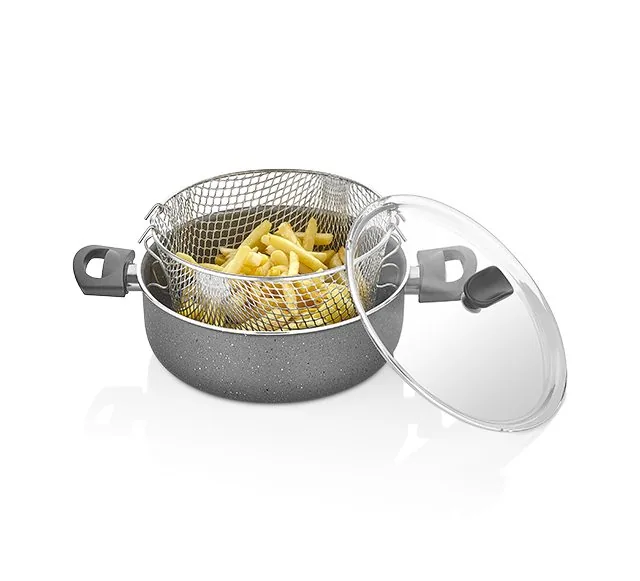
Hotel, restaurant and catering kitchens retire consumer-grade cookware within months: dozens of heat cycles a day, constant washing and fast-moving crews are a different duty profile. Here is what to specify when buying cookware for HoReCa use — from a manufacturer that supplies it.
What professional use does to a pan
A home pan sees a few uses a week; a HoReCa pan can see dozens a day, rapid temperature swings, back-to-back washing and whichever utensil is closest to hand. Every specification below follows from that duty cycle, not from brand preference.
Body: thickness first
Thin bodies warp under daily thermal shock — and a warped base loses hob contact, cooks unevenly and wastes energy. Specify thick-gauge aluminium, pressed or forged: aluminium keeps the weight workable for a crew handling pans hundreds of times a shift, while a thick, machined base stays flat. This is the single most important line on a HoReCa spec sheet.
Coating: treat it as a consumable
Even a quality non-stick coating is a consumable in professional use — plan a replacement cycle rather than expecting domestic lifespans. What matters commercially: a reinforced coating specified for heavy use, food-contact certification for your market (LFGB, FDA and the rest), and a supplier who can deliver the same product again when you reorder, so the line stays uniform across the kitchen.
Induction in professional kitchens
Induction is increasingly standard in new commercial kitchens — faster, cooler and easier to keep clean. If any of your stations run induction, standardise on induction-based series so every pan works at every station: at Papilla, series with "Plus" in the name and the Motto series. The full range: induction cookware.
Sizes and fleet planning
Plan the fleet around the menu, not piece by piece: large-diameter frypans and sauté pans for service, deep casseroles in several volumes for stocks and batch cooking, and duplicates of the sizes that carry the rush. Standardising on one series simplifies lids, stacking and reordering.
How to buy
Papilla manufactures aluminium cookware in Türkiye and exports to 85+ countries — supplying distributors, hotel groups and foodservice buyers directly, including private-label programs for HoReCa distributors. For volume pricing and catalogues, use the contact page; for order mechanics see MOQs, lead times and sampling.
Frequently asked questions
What does HoReCa mean?
Hotel, Restaurant and Café/Catering — the foodservice channel. HoReCa cookware is specified for professional duty: dozens of heat cycles a day, constant washing and heavy handling.
Does Papilla supply hotels and restaurants?
Yes. Papilla manufactures in Türkiye and exports to 85+ countries, supplying distributors, hotel groups and foodservice buyers at volume — including private-label programs for HoReCa distributors. Use the contact page for volume pricing.
How long does non-stick cookware last in a professional kitchen?
Far less than at home — in professional use a coating is a consumable. Plan a replacement cycle and standardise on one series so reorders match the existing fleet exactly.
Should a professional kitchen buy induction-compatible cookware?
If any station runs induction, yes — standardising on an induction-based series means every pan works at every station, and it also covers gas, electric and ceramic hobs.