

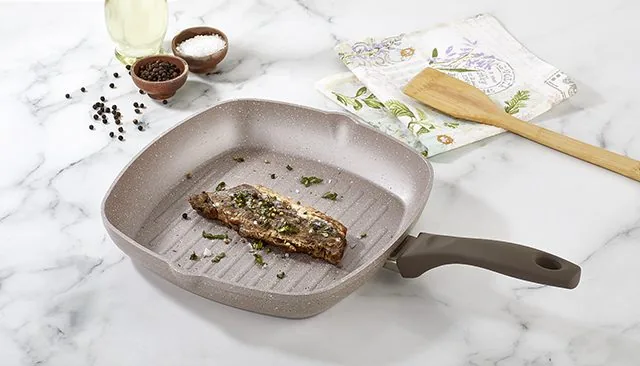
The coating is what your customer touches every day — and the first thing that fails if it's cheap. Here's a plain-English primer on non-stick cookware coatings: what they are, how manufacturers apply them, and what to specify.
The non-stick (PTFE) interior
PTFE non-stick gives the smooth, easy-release surface most cooks expect: food slides off, cleaning is quick, and far less oil is needed. It's the workhorse interior across promotional and mid-tier ranges. Performance depends less on the name and more on how many layers are applied and how well the aluminium body underneath is prepared — see the fundamentals in our aluminium & induction cookware guide.
Exterior finishes
The outside of the pan is finished separately from the interior — commonly a silicone-polyester paint or a non-stick-based paint. The exterior sets the look on the shelf and the heat- and stain-resistance of the outside of the pan. It's also where colour and branding live, so for a private-label program the exterior is a key spec.
How coatings are applied: roller, curtain, spray
Manufacturers use three application methods, and the choice affects cost, finish and which price tier a line can hit:
| Method | How it works | Best for |
|---|---|---|
| Roller | Coating rolled onto the surface — efficient and even | High-volume promotional lines |
| Curtain | Coating falls as a "curtain" over the body for a smooth, uniform layer | Consistent mid-tier finishes |
| Spray | Coating sprayed on — the most flexible method | Premium and textured finishes |
Because Papilla runs all three on the same production line, one tooling set can serve promotional to premium — useful when a buyer wants a good/better/best range under one brand.
Layers, thickness and durability
More coating layers, applied over a well-prepared and appropriately thick aluminium body, generally mean better durability and scratch resistance. When you compare quotes, the layer count and the aluminium gauge explain most of the price difference — it's rarely worth chasing the cheapest surface.
Care that makes non-stick last
Whatever the grade, non-stick lasts longest with a few habits worth printing on your care card:
- Use low-to-medium heat — high heat shortens any non-stick's life.
- Use wood, silicone or nylon utensils, not metal.
- Let the pan cool before washing; avoid harsh abrasives.
What to specify as a buyer
For a coating that matches your market and price point, tell the manufacturer: interior coating grade and layer count, exterior finish and colour, any induction requirement, and the destination market (for food-contact compliance such as LFGB or FDA). Explore the full product range to see coatings in context, or request samples.
Frequently asked questions
What is PTFE non-stick coating?
PTFE is the material behind most non-stick cookware. It gives a smooth surface that releases food easily, cleans quickly and needs little oil. Its durability depends on how many layers are applied and how well the pan body underneath is prepared.
What's the difference between roller, curtain and spray coating?
They are three ways to apply the coating. Roller is efficient and even, good for high-volume promotional lines; curtain pours the coating as a uniform layer for consistent mid-tier finishes; spray is the most flexible and is used for premium and textured finishes.
How do I make non-stick cookware last longer?
Use low-to-medium heat, use wood, silicone or nylon utensils instead of metal, let the pan cool before washing, and avoid harsh abrasives. High heat and metal tools are what shorten a non-stick coating's life.
What should I specify when ordering coated cookware?
Tell the manufacturer the interior coating grade and layer count, the exterior finish and colour, any induction requirement, and your destination market so the coating meets local food-contact standards such as LFGB (EU) or FDA (USA).