

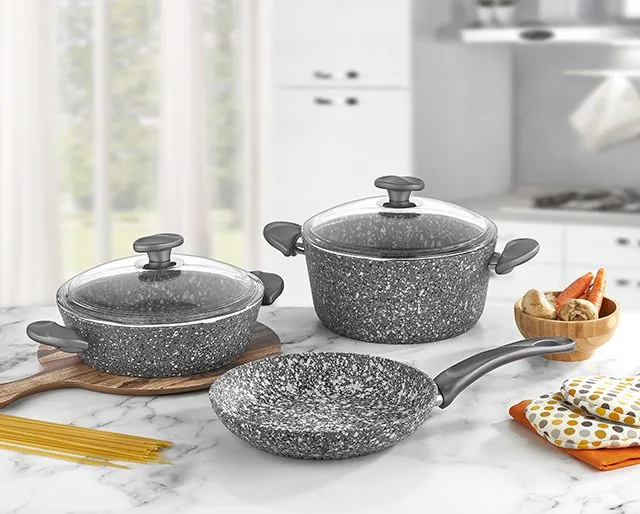
Choosing a cookware supplier is a long-term decision — coating quality, consistency and compliance only show up months after the first order lands. This checklist walks through what a wholesale, retail or private-label buyer should verify before committing to a partner.
First: manufacturer or trading company?
The single most important question. A manufacturer owns the factory, controls the raw material and coatings, and can change specifications, moulds and quality directly. A trading company resells other factories' output — adding a margin and a layer of distance from quality control. Neither is inherently wrong, but you must know which you're dealing with, because it determines who actually answers for a defect. Papilla is a manufacturer: aluminium discs, pressing/forging, coating and assembly all happen in-house — see how OEM manufacturing works.
Certifications — ask for the documents, and check the dates
A serious manufacturer holds and renews these; an expired certificate is a warning sign:
- ISO 9001 — quality management, the baseline for consistent production.
- ISO 14001 — environmental management, increasingly required by EU retailers.
- BSCI / SEDEX / ICS — social-compliance audits covering labour and ethics; many importers and large retailers mandate at least one.
- Food-contact compliance for your market — e.g. LFGB (EU) or FDA (USA). Always confirm the coating and materials meet the standard where you sell.
See Papilla's quality & certifications for the full list.
Vertical integration and quality control
Suppliers who control their inputs deliver more consistent runs than those assembling bought-in parts. Ask three things: where the aluminium comes from, who supplies the coating chemistry, and how quality is checked during production — not just at the end. Strong suppliers run in-process checks plus a pre-shipment inspection against an agreed AQL (acceptable quality limit), and will let you or a third party (SGS, Bureau Veritas, Intertek) inspect before the container ships.
What to check on a sample
Before you commit, request samples and verify:
- Coating adhesion — no bubbling or flaking; ask about layer count.
- Base flatness — a rectified base sits flat; rock it on a hard surface.
- Gauge / thickness and weight — thicker aluminium resists warping.
- Handle attachment — riveted or welded, tight and heat-resistant.
- Induction test — if relevant, a magnet should hold firmly to the base (see induction compatibility).
MOQ, lead times and capacity
Match the supplier's scale to your programme. Ask for realistic minimum order quantities per model and colour, sampling time, and production lead times — and whether they can scale if your line succeeds. A manufacturer running automated production (Papilla runs roughly 2,000,000 pieces/month) can absorb growth a small workshop cannot.
Private-label and OEM capability
Can the supplier deliver your branding, colours, packaging and custom shapes? A manufacturer with an in-house mould shop can develop new shapes and hold tolerances without a third party — faster sampling, and designs that stay exclusive to you. Confirm the specifics: logo on handle or base, custom colours, retail-ready packaging, barcodes.
Export, logistics and documentation
A supplier already exporting widely understands what you'll need: correct HS codes, certificates of origin, food-contact declarations, and packaging that survives long transit and loads a container efficiently. Ask which Incoterms they work with (EXW, FOB, CIF…) and how they optimise carton and container fill — it directly affects your landed cost. Papilla ships to 85+ countries and has manufactured since 1999.
Pricing and payment
The lowest quote is rarely the cheapest over a season — thin aluminium and weak coatings come back as returns. Understand what drives the price (gauge, coating grade and layers, accessories, packaging) so you compare like with like. Clarify payment terms (a deposit plus balance against shipping documents is common) and who carries the cost of a failed inspection.
Red flags
- No certificates provided on request, or expired ones
- Vague answers on where the aluminium and coating come from
- No samples, or samples that don't match the catalogue
- No export references or track record in your market
- A price far below everyone else — usually thinner metal or fewer coating layers
A quick supplier scorecard
Score each candidate 1–5 across these and compare:
- Manufacturer (not trader) · certifications current · material sourcing transparent
- In-process QC + pre-shipment inspection · sample quality · induction option if needed
- MOQ & lead-time fit · capacity to scale · private-label capability
- Export experience in your market · Incoterms flexibility · clear pricing & terms
Ready to evaluate one? See Papilla's capabilities or browse the range.
Frequently asked questions
Should I buy cookware from a manufacturer or a trading company?
Buy from a manufacturer when you can. A manufacturer owns the factory, controls the raw aluminium and coatings, and answers directly for quality and specification changes. A trading company resells other factories' products with an added margin and less control over quality.
What certifications should a wholesale cookware supplier have?
At minimum ISO 9001 (quality) and ISO 14001 (environmental), plus a social-compliance audit such as BSCI, SEDEX or ICS. Confirm food-contact compliance for your market too, such as LFGB in the EU or FDA in the USA.
How do I check cookware quality before ordering?
Request samples and check coating adhesion, base flatness, aluminium thickness and weight, and handle attachment. For induction ranges, a magnet should stick firmly to the base. Arrange a pre-shipment inspection against an agreed AQL, optionally by a third party such as SGS or Bureau Veritas.
What is a typical MOQ for private-label cookware?
It varies by model, colour and packaging, so ask each supplier for minimum order quantities per SKU and colour, along with sampling and production lead times and whether they can scale as your programme grows.